
How We Predict Football Results
Using Data Science to Forecast Match Outcomes
What is Poisson Distribution?
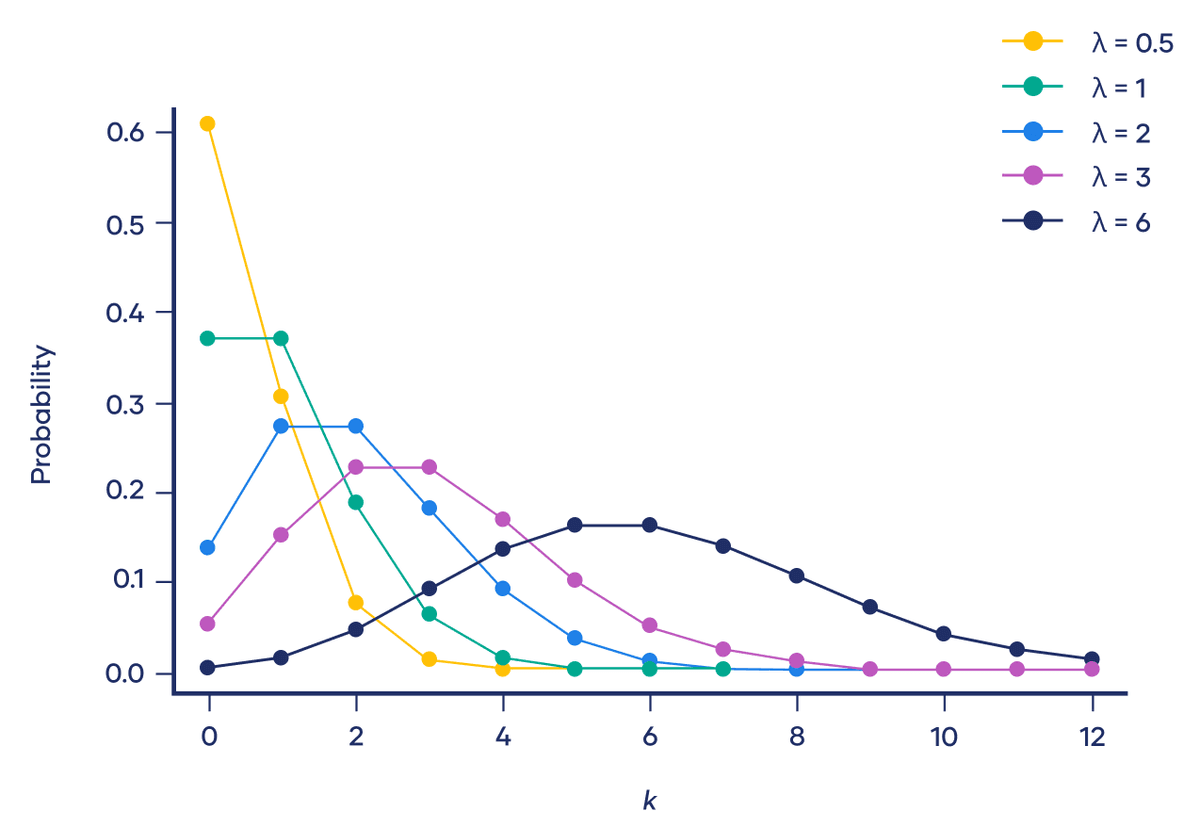
Think of Poisson distribution as a way to predict how many times something will happen. Imagine you're trying to guess how many customers will walk into a coffee shop in the next hour, or how many goals a football team will score in a match.
The key idea is simple: if you know how often something usually happens, you can calculate the probability of it happening different numbers of times. For football, this means if we know a team typically scores 1.5 goals per game, we can figure out how likely they are to score 0, 1, 2, 3, or more goals in their next match.
It's like weather forecasting, but for goals. Just as meteorologists use historical weather patterns to predict tomorrow's weather, we use historical goal-scoring patterns to predict match outcomes.
How We Use It for Football Predictions
Calculate Expected Goals
First, we figure out how many goals each team is likely to score. We don't just use simple averages - we look at their recent form, home or away advantage, head-to-head history, and even factor in injuries. This gives us an "expected goals" number for each team.
Example: If Team A averages 2 goals per game at home, and they're playing at home against a weaker defense, we might expect 2.2 goals.
Calculate Probabilities
Using Poisson distribution, we calculate the probability of each team scoring 0, 1, 2, 3, or more goals. This tells us how likely different scorelines are.
Example: Team A might have a 15% chance of scoring 0 goals, 30% chance of 1 goal, 35% chance of 2 goals, and so on.
Combine the Probabilities
We then combine the probabilities from both teams to predict the most likely match outcome. We calculate the probability of Team A winning, Team B winning, or a draw by looking at all possible score combinations.
Example: If Team A has a 40% chance of scoring 2 goals and Team B has a 25% chance of scoring 1 goal, the probability of a 2-1 result is 10% (40% × 25%).
Generate Predictions
Finally, we use all these probabilities to make our predictions. We show you the most likely outcome, along with a confidence level that tells you how certain we are. Higher confidence means the data strongly supports that prediction.
Example: If Team A has a 65% chance of winning based on all calculations, we'll predict a Team A win with 65% confidence.
What Makes Our Approach Different
We don't just plug numbers into a formula and hope for the best. Our approach is more sophisticated:
- ✓Context Matters: We adjust our calculations based on recent form, injuries, and team news. A team that's won 5 games in a row gets different treatment than one on a losing streak.
- ✓Multiple Factors: We consider head-to-head records, home advantage, league position, and even weather conditions when available.
- ✓Continuous Learning: Every match result helps us improve. We track our accuracy and refine our models based on what we learn.
- ✓Transparency: We show you confidence levels and explain our reasoning. You always know how certain we are about each prediction.
A Real-World Example
Example Match: Manchester United vs. Liverpool
Step 1: We analyze both teams' recent performance:
- Manchester United: Averaging 1.8 goals per game at home, won 4 of last 5 home matches
- Liverpool: Averaging 1.5 goals per game away, strong recent form
- Head-to-head: Close matches, often 1-1 or 2-1 results
Step 2: We calculate expected goals:
- Manchester United: 1.9 expected goals (slightly above average due to home advantage)
- Liverpool: 1.4 expected goals (strong team but away from home)
Step 3: We calculate probabilities:
- Most likely score: 2-1 to Manchester United (18% probability)
- Draw (1-1): 15% probability
- Liverpool win (1-2): 12% probability
Step 4: Our prediction:
Manchester United to win - 52% confidence
This means based on all our calculations, we believe there's a 52% chance Manchester United will win this match.
Remember: Even with 52% confidence, there's still a 48% chance of a different outcome. That's why we show confidence levels - to help you understand the uncertainty in any prediction.
Why This Matters
Transparency
You understand how predictions are made. No black box - we explain our methodology and show confidence levels.
Data-Driven
Our predictions are based on real data and statistical analysis, not gut feelings or guesswork.
Always Improving
Every match result helps us learn and refine our models. We track our accuracy and continuously improve.